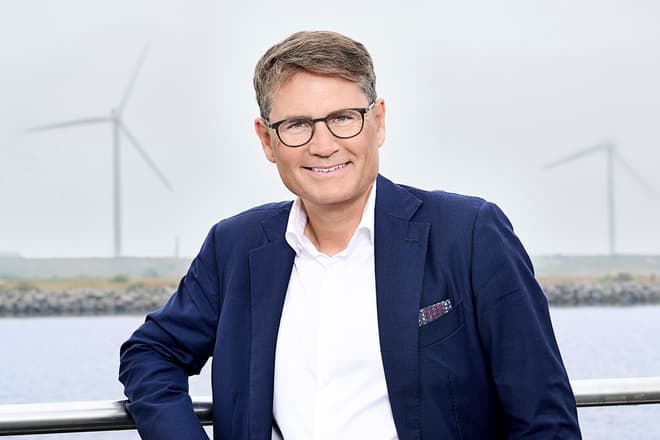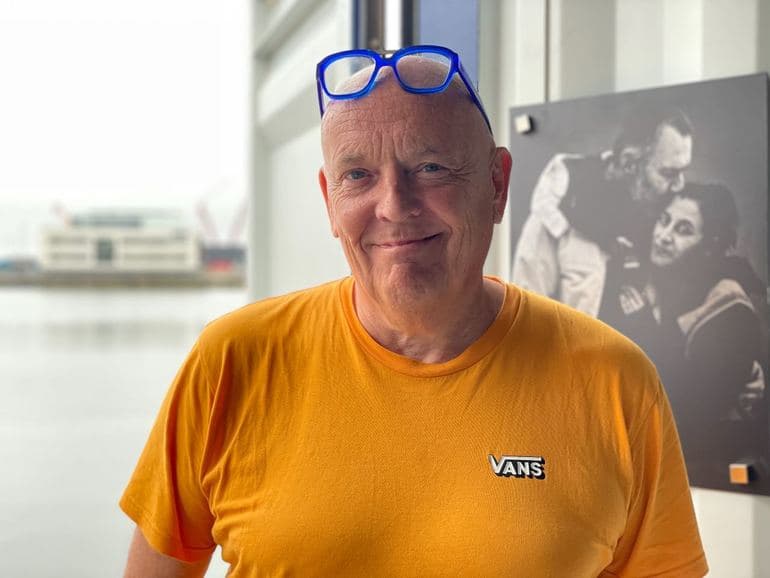
Søren Zeuth has no doubt: There are migrant workers in all industries in Denmark, and the offshore industry is no exception.
- I have had contact with migrant workers who work offshore, but they don't want to be involved. But I see it in all industries, says Copenhagen photographer Søren Zeuth.
For the past two or three years, he has worked to raise awareness of migrant workers in Denmark through his photo portraits, which are on display at Esbjerg Harbour this weekend.
- They are hard to find, and they live in secret. Sometimes the six people live in a small house, which may even be rented out by their employer, explains Søren Zeuth, who gives an example of how he found a migrant worker:
- My ex-wife's boyfriend's neighbor's son has a strawberry plantation in South Zealand.
This is where one of the portraits of a seasonal worker on the strawberry plantation comes from, printed on brushed aluminum, which hangs on the inside of the container with very strong magnets.
- I want to give them a voice so that we respect and recognize them as people. They tell me that they want to be accepted and looked at. We know from figures from the Ministry of the Interior that 368,000 people with foreign passports worked in Denmark last year. And I have no doubt that the hidden figure is even higher for people who are here illegally, says Søren Zeuth.
He has a very concrete example.
- Here is a man from Gambia who first paid people smugglers $5,000 (approximately DKK 34,000) to enter Europe. He then paid 43,000 euros (approximately DKK 320,000) for a false identity, which he earned by working at a hotel in Denmark. He never saw a paycheck. He ended up being discovered when he contracted tuberculosis and was hospitalized in Denmark. In May, he was deported to Gambia, says Søren Zeuth.
Started in Germany
The free movement of labor within the EU helps create the fertile ground for migrant work. But the photographer also sees responsibility for the fact that migrant workers often end up with low wages somewhere.
- German Chancellor Gerhard Schröder said in the zero years that it is important to have a low-wage sector. We have created an underclass that everyone knows exists, he states.
However, there are some who are fighting against this trend.
- Trade unions like 3F are making a great effort. In Copenhagen, for example, they create clubs for each individual country, so that migrant workers meet with their compatriots there, and then they are informed about their rights, explains Søren Zeuth, who has so far made 50 portraits. The goal is to reach 100 portraits within a few years and publish a book with them.
But in the coming weeks, Søren Zeuth will be on tour with his container exhibition called "The New Nomads/Cargo" in Jutland.
- Next week I will go to Kulturmøde Mors, and in week 35 I will be at Sønder Torv in Vejle, says Søren Zeuth, who is ready to tell his portraits.
The container exhibition runs this weekend at Britanniavej 3, 6700 Esbjerg in front of Huset Gammelhavn by the quayside. The exhibition is supported by the Jutland Art Foundation.
Updated August 20, 2024 at 9:27 a.m.
Text, graphics, images, sound, and other content on this website are protected under copyright law. DK Medier reserves all rights to the content, including the right to exploit the content for the purpose of text and data mining, cf. Section 11b of the Copyright Act and Article 4 of the DSM Directive.
Customers with IP agreements/major customer agreements may only share Danish Offshore Industry articles internally for the purpose of handling specific cases. Sharing in connection with specific cases refers to journaling, archiving, or similar uses.
Customers with a personal subscription/login may not share Danish Offshore Industry articles with individuals who do not themselves have a personal subscription to Danish Offshore Industry.
Any deviation from the above requires written consent from DK Medier.