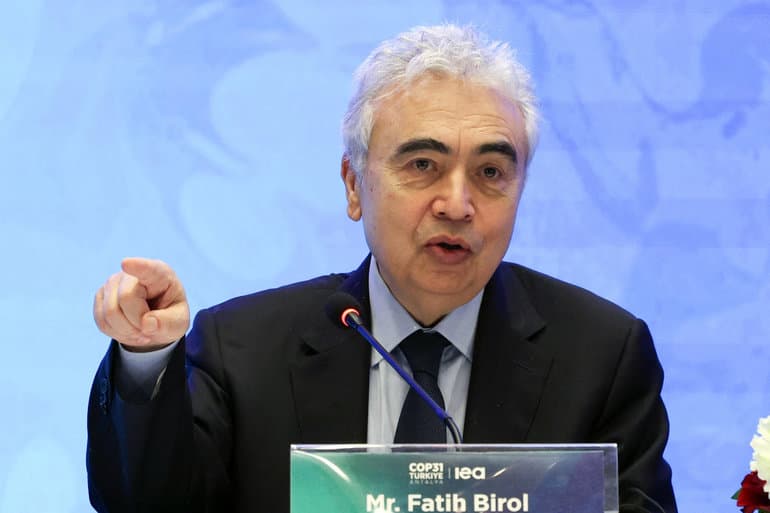
The war in Iran has caused the most severe energy shock ever, and it will take up to six months or longer for the flow of oil and gas from the Gulf to be restored. This was stated by the director of the International Energy Agency (IEA), Fatih Birol, to the Financial Times on Friday.
- People understand that this is a big challenge, but I am not sure that the depth and the consequence of the situation are fully understood, he said in an interview according to the Financial Times.
Birol also helped shape Europe's response to the gas crisis that came in the wake of Russia's invasion of Ukraine, and according to him, the amount of gas that was cut off as a result of the conflict in Iran is twice as large as what Europe lost in 2022.
According to the energy director, the current situation is "the greatest global threat to energy security in history".
The reason why the flow of oil and gas is being affected by the current situation in the Middle East is that approximately a fifth of all the world's oil is transported through the Strait of Hormuz. The strait lies south of Iran and connects the Persian Gulf and the Gulf of Oman, and since the US and Israel launched their first attacks on Iran on February 28, very few ships have passed through the strait.
In his explanation of why it will take so long for the oil and gas flow to be restored, Birol highlights that many oil and gas fields are either completely shut down or damaged by attacks, and therefore cannot simply reopen from one day to the next.
He did not want to comment to the Financial Times on how high he expects oil and gas prices to rise, but he states that prices are likely to continue to rise as long as the strait is closed to shipping.
The IEA announced last week the release of 400 million barrels of oil and refined products from global storage to meet the global shortage of oil, with Denmark as a member of the IEA releasing 1,246,000 barrels of oil over a period of up to 90 days.
According to Birol, a total of 20 percent of the energy agency's oil reserves were released. However, the energy director does not believe that in the long run they can compensate for the loss of energy from the Middle East, and the most important goal is therefore, according to him, to reopen the Strait of Hormuz to shipping.
/ritzau/
Text, graphics, images, sound, and other content on this website are protected under copyright law. DK Medier reserves all rights to the content, including the right to exploit the content for the purpose of text and data mining, cf. Section 11b of the Copyright Act and Article 4 of the DSM Directive.
Customers with IP agreements/major customer agreements may only share Danish Offshore Industry articles internally for the purpose of handling specific cases. Sharing in connection with specific cases refers to journaling, archiving, or similar uses.
Customers with a personal subscription/login may not share Danish Offshore Industry articles with individuals who do not themselves have a personal subscription to Danish Offshore Industry.
Any deviation from the above requires written consent from DK Medier.