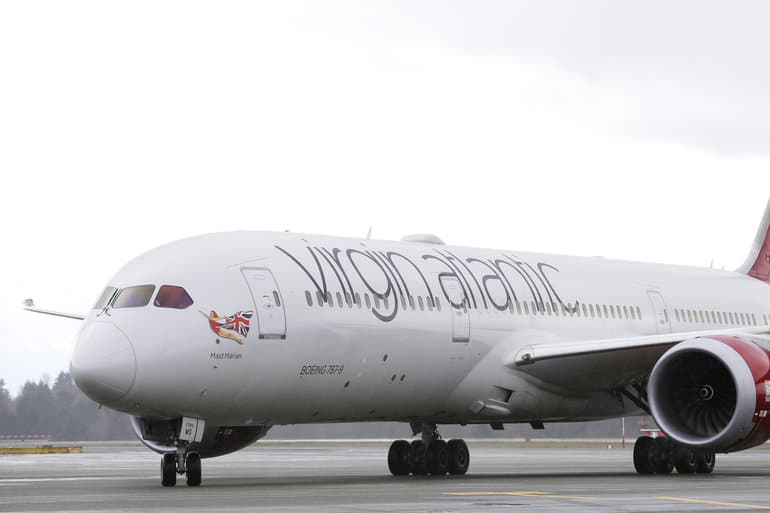
Today, Tuesday, a very special Virgin Atlantic passenger plane will take off from London Heathrow Airport and head for New York JFK Airport. The plane will be the first passenger plane to cross the Atlantic Ocean powered entirely by a renewable fuel called SAF (Sustainable Aviation Fuel).
The aviation industry sees Tuesday's flight as a way to show the world that there is potential for more environmentally friendly aviation. The plane is a Boeing 787 with engines from Rolls-Royce.
The flight comes after a smaller Gulfstream G600 business jet made a successful crossing using the same fuel.
Virgin Atlantic's founder, billionaire Richard Branson, the airline's CEO, Shai Weiss, and Britain's Transport Secretary, Mark Harper, will all be on board the plane.
It is scheduled to take off from London at 11:30 local time. That's 12:30 in Denmark. It will land in New York at 2:40 p.m. local time, which is 8:40 p.m. Danish time. There will be no paying passengers or cargo on board the plane, which Virgin is calling Flight100.
Environmental organization: An example of greenwashing
The flight takes place just days before the COP28 climate summit starts in Dubai on Thursday. SAF is already used in some aircraft as part of a blend with traditional petroleum.
After a series of successful tests, Virgin, along with its partners Rolls-Royce, Boeing, BP and others, has been allowed to fly using only SAF.
Aviation accounts for about two to three percent of global carbon emissions. SAF could be a step in the right direction in terms of reducing emissions, but it is expensive and can only cover 0.1 percent of all aviation fuel used today.
The fuel is made from cooking oil and animal fat, as well as a small amount of synthetic aromatic kerosene, which consists of corn residues, according to Virgin Atlantic.
Although there is enthusiasm for the flight from both Virgin Atlantic and the British government, it has also met with criticism. The environmental organization Stay Grounded calls the flight a distraction in the form of greenwashing.
- Alternative fuel is nowhere near scalable in the time frame necessary to avoid climate collapse. What is urgently needed is to reduce the use of fossil aviation fuel, which means reducing flights whenever possible, says Magdalena Heuwieser, who represents the network.
/ritzau/Reuters
Text, graphics, images, sound, and other content on this website are protected under copyright law. DK Medier reserves all rights to the content, including the right to exploit the content for the purpose of text and data mining, cf. Section 11b of the Copyright Act and Article 4 of the DSM Directive.
Customers with IP agreements/major customer agreements may only share Danish Offshore Industry articles internally for the purpose of handling specific cases. Sharing in connection with specific cases refers to journaling, archiving, or similar uses.
Customers with a personal subscription/login may not share Danish Offshore Industry articles with individuals who do not themselves have a personal subscription to Danish Offshore Industry.
Any deviation from the above requires written consent from DK Medier.