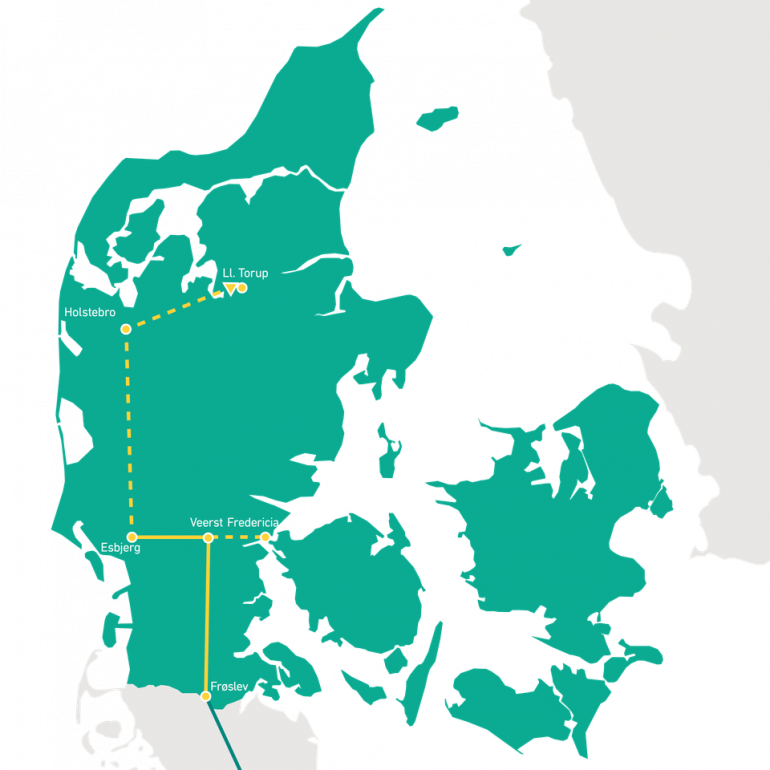
Energinet has opened the capacity sale for Danish Hydrogen Backbone 1, also known as the 7th, which is the first stage of Denmark's upcoming hydrogen infrastructure. This means that for the first time, producers and customers can request transport capacity in the planned hydrogen pipeline from Esbjerg via Veerst to Frøslev at the Danish-German border. The state-owned company announced this in a press release.
According to Energinet, the opening marks a shift from initial and non-binding dialogue to binding market needs. For the first time, the players can translate plans into concrete volumes and agreements, which will give Energinet a more precise picture of demand and the time horizon the market is working with.
According to the political framework, the hydrogen infrastructure can only be established if the market as a whole books at least 0.5 GW of transport capacity measured in lower calorific value. The requirement is to ensure an economically sustainable basis before a final decision is made on the plant and later expansion.
- The capacity sale gives us a clearer picture of the need for the transport of green hydrogen and the time horizon that the players are working with – and this creates the predictability that both producers and customers need. At the same time, the market can now translate plans into concrete volumes and agreements. The minimum booking of 0.5 GW will be an important indicator of the pace – and a necessary basis for the realization of the first stage of Denmark's hydrogen infrastructure, says Michael Linnemann Pedersen, Area Manager for Megaprojects at Energinet.
The capacity sale runs until December 1, 2026. Energinet offers a total of 2.7 GW of transport capacity from December 31, 2030 to January 1, 2046 via the PRISMA platform.
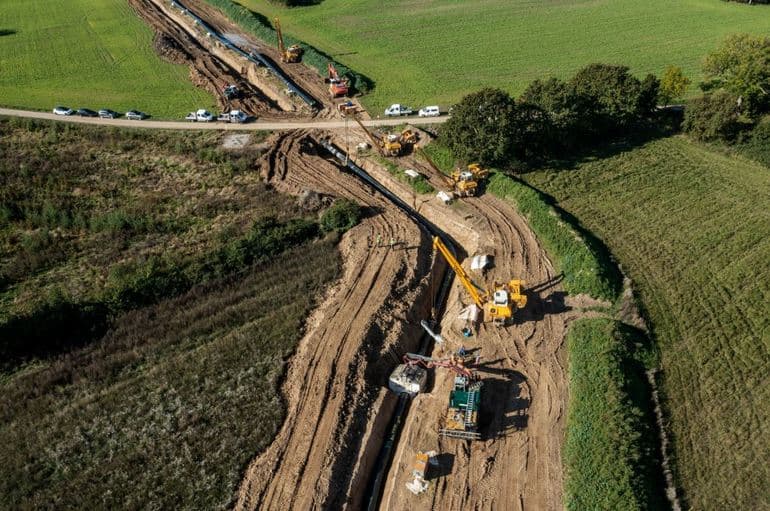
Danish Hydrogen Backbone 1 is planned as the first part of a coherent hydrogen pipeline system that will eventually connect Danish production of green hydrogen with industrial consumers, storage and export to Germany. The project is being carried out in close collaboration with Gasunie Deutschland, which is Energinet's counterpart on the German side of the border. According to the plan, construction work is to begin in mid-2028, while the hydrogen pipeline is expected to be in operation by the end of 2030.
amp
Text, graphics, images, sound, and other content on this website are protected under copyright law. DK Medier reserves all rights to the content, including the right to exploit the content for the purpose of text and data mining, cf. Section 11b of the Copyright Act and Article 4 of the DSM Directive.
Customers with IP agreements/major customer agreements may only share Danish Offshore Industry articles internally for the purpose of handling specific cases. Sharing in connection with specific cases refers to journaling, archiving, or similar uses.
Customers with a personal subscription/login may not share Danish Offshore Industry articles with individuals who do not themselves have a personal subscription to Danish Offshore Industry.
Any deviation from the above requires written consent from DK Medier.