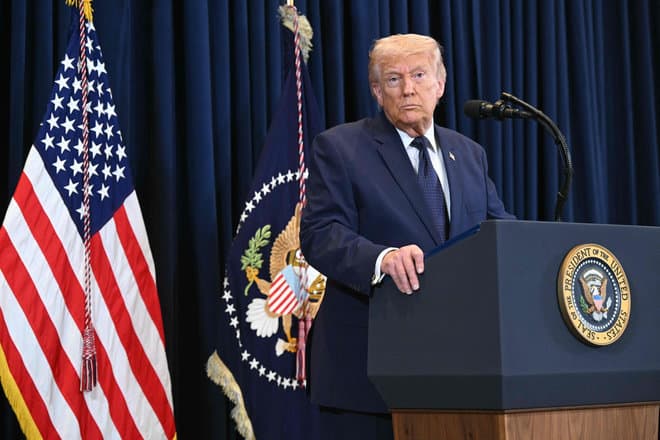
Opinion polls in the US have repeatedly shown that President Trump lacks support for the violent showdown with Denmark over Greenland. Even among Republican voters, there is widespread skepticism.
Yet the US president chose to escalate the situation further over the weekend by threatening a number of named European countries with tariffs. The showdown is no longer just between the US and the Kingdom of Denmark, according to the admission in Brussels.
At Sunday's meeting of the EU countries' permanent representatives, several EU countries made it clear that it is now effectively a showdown between Trump's US and Europe. At stake is not just Greenland, but the very international legal order and the survival of the NATO alliance. The mood has thus changed in a short time.
A few weeks ago, parts of the EU would not reject the possibility of sacrificing Greenland in order to maintain the NATO alliance with the US. Now, the rallying around and support for Denmark has increased significantly. The EU's goal, however, is to continue to engage in dialogue with the Trump administration rather than escalate the situation. This was stated by EU Commission spokesman Olof Gill on Monday.
- Sometimes the most responsible form of leadership is to show restraint. Responsible leadership is what Ursula von der Leyen and the entire EU stand for, said Olof Gill.
The EU also chose a restrained approach during last year's trade show with Trump. At that time, the goal was also to avoid an escalation, which did not have the desired effect. The question is whether the EU actually has the courage and ability to strike hard again this time if Trump takes the threats seriously.
France ready to strike hard
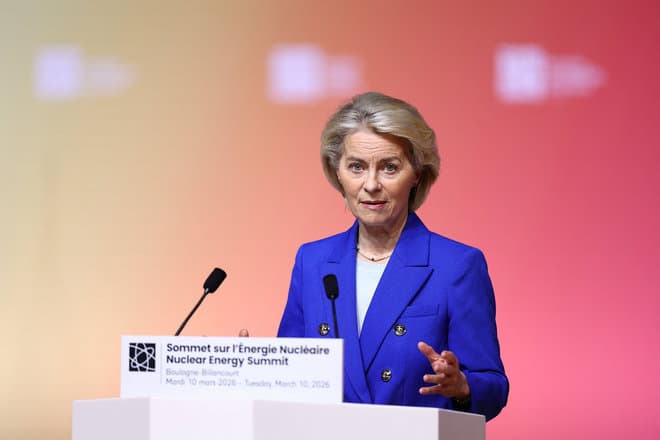
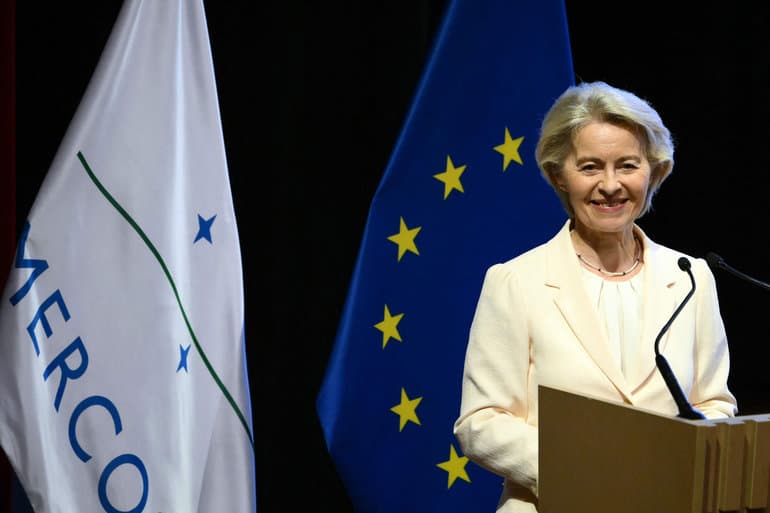
The first test of strength is expected to be in Davos. EU Commission President Ursula von der Leyen will speak here on Tuesday, before Trump is expected to dominate the World Economic Forum meeting on Wednesday. The question of a countermeasure will then be at the center of the extraordinary EU summit in Brussels on Thursday.
The EU has already prepared countermeasures for 93 billion euros on American goods in connection with the trade agreement this summer. These tariffs can be quickly activated as a first step. This corresponds to American goods worth around 690 billion Danish kroner being hit by European countermeasures.
However, French President Emmanuel Macron wants to hit Trump significantly harder. Macron is in favor of activating the EU's previously never-used anti-coercive tool. It is also called the EU's "trade bazooka" because it is the most far-reaching economic intervention the EU can make against a third country. It can be adopted in two rounds by qualified majority. This means that Hungary, for example, cannot block.
The first step is for the EU to determine that this is an attempt at "economic coercion" against a member state. Brussels believes that this criterion has been met. Not least after Trump's latest threats of tariffs on European countries.
The next step is for the leaders of the EU countries to decide what exactly the "bazooka" should hit. The finance ministers of France and Germany were to discuss this on Monday, the French administration announced over the weekend.
Can hit IT giants
In the most far-reaching version, Europe could choose to completely exclude American suppliers from the EU. This could, for example, be American digital giants such as Microsoft, Google and Amazon. The problem is that it could also partially paralyze European companies. The three companies dominate the European market for cloud solutions, where the United States accounts for around 70 percent of the market in Europe.
This is one of the reasons why Europe would prefer to see a diplomatic solution. According to the EU Commission, contacts with the US administration are now taking place at "all levels".
At a meeting in Washington last week, Foreign Minister Lars Løkke Rasmussen (M) agreed to a working group with the Trump administration. It will look at solutions other than direct American "ownership" of Greenland.
Germany, France and the UK are now expected to bring in the heavy diplomatic guns. The goal is to influence the people around Trump and the big American companies and get Trump to back down.
/ritzau/
Text, graphics, images, sound, and other content on this website are protected under copyright law. DK Medier reserves all rights to the content, including the right to exploit the content for the purpose of text and data mining, cf. Section 11b of the Copyright Act and Article 4 of the DSM Directive.
Customers with IP agreements/major customer agreements may only share Danish Offshore Industry articles internally for the purpose of handling specific cases. Sharing in connection with specific cases refers to journaling, archiving, or similar uses.
Customers with a personal subscription/login may not share Danish Offshore Industry articles with individuals who do not themselves have a personal subscription to Danish Offshore Industry.
Any deviation from the above requires written consent from DK Medier.