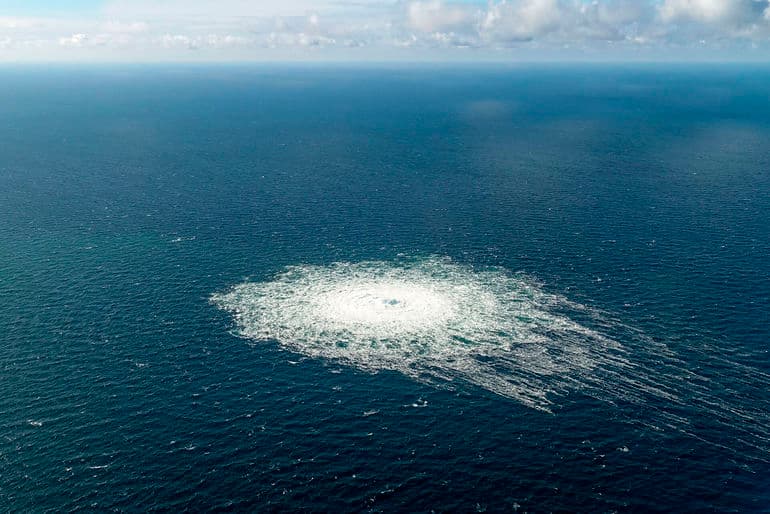
If the Ministry of Foreign Affairs and the Ministry of Climate Change have their way, Denmark will avoid worries and climate fines in the billions for the leak on the Nord Stream 1 and 2 gas pipelines in September 2022. This is shown by a document access from Klimamonitor to the EU Commission.
In an application to the EU, officials from Sweden and Denmark are lobbying together for changes that will exempt the two countries "from being unfairly hit by an additional reduction burden as a consequence of the sabotage of the Nord Stream 1 & 2 gas pipelines."
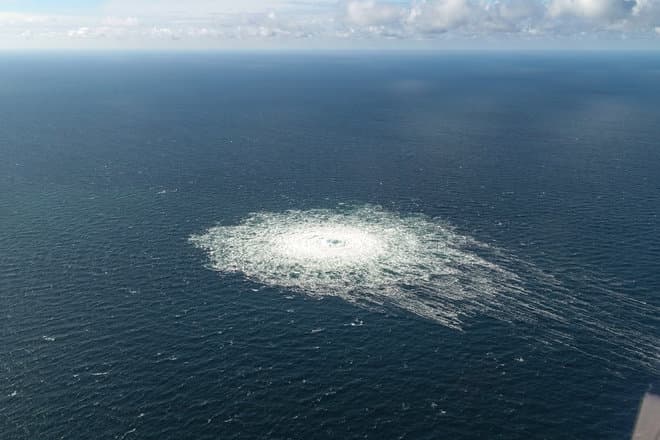
If an EU country neglects to cut its greenhouse gas emissions by 2030, fines from the EU are imminent. Here, the gas leak caused by unknown perpetrators on the Nord Stream pipes has on paper made it significantly more difficult for Denmark to meet its climate obligations in the EU.
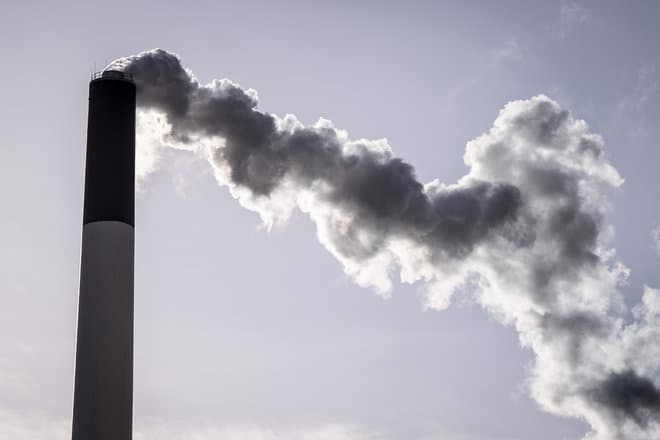
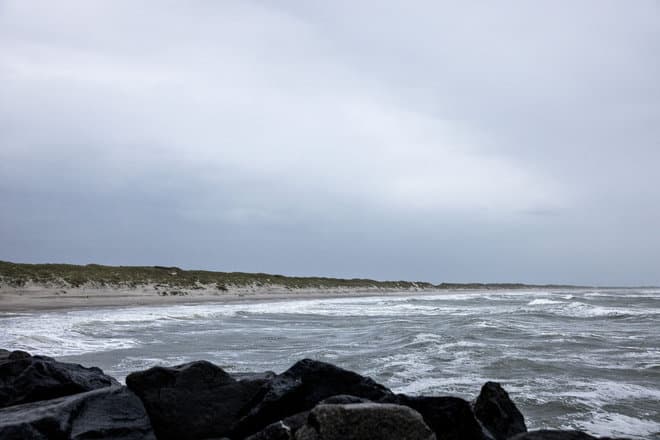
The release of methane from the leak in the gas pipe 20 km off Bornholm corresponds to 18 percent of Denmark's total emissions in 2022. In absolute figures, this is 8.4 million tons of CO2e. In comparison, Danish industry emitted just under 5.9 million tons of CO2e in 2022.
Denmark is liable for climate pollution
Although Denmark does not profit from the German-owned gas pipes with Russian gas, Denmark is liable on paper for climate pollution. This is because the gas leak took place in Danish territorial waters, where Danish environmental law and the right to dispose of resources apply, but where foreign states also have the right to build underwater pipelines.
Officials from Sweden and Denmark are therefore trying to convince the EU Commission that Denmark and other nations should not be liable for climate pollution caused by sabotage.
The reaction from the EU Commission to Denmark and Sweden's pressure for the exemption is not insignificant. The many millions of tons of CO2 from the gas leak in the Baltic Sea will most likely cost the two countries billions of kroner when the burden sharing between the EU countries is to be settled in 2030.
Exactly how much is associated with uncertainty, but German economists estimated in January that the leak will cost somewhere between 50 and several hundred euros per ton.
Could end in a fine of six billion. DKK.
According to a study conducted for Klimamonitor by Concito's senior analyst Karsten Capion, Denmark therefore risks a fine of between three and six billion. DKK. This will happen if the price ends up at 100-200 euros per ton out of the 8.4 million tons of CO2 from the gas leak in Danish waters – minus the adjustment of the compensation ceiling that the significant footprint will result in.
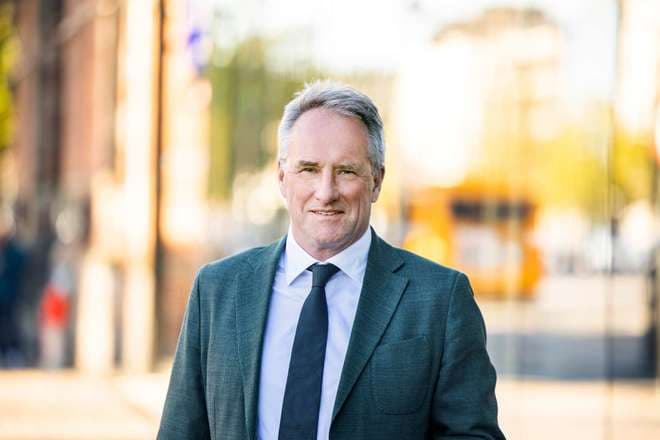
Minister of Climate, Energy and Utilities Lars Aagaard (M) will not comment on any details about Denmark's meeting with the EU Commission and ongoing correspondence about having an exception for sabotage written into the EU rules.
- I of course do not believe that Denmark's achievement of climate goals should be affected by explosions on other countries' gas pipelines, Lars Aagaard stated in January.
The Minister of Climate has the support of Mogens Fosgerau, who is a professor of economics at the University of Copenhagen, specializing in national climate accounts, among other things. He points out that the purpose of the territorial, country-based distribution of responsibility is that responsibility should lie where emissions can best be regulated.
- Sabotage like this is quite difficult to control and regulate. That's why I think it's perfectly fine to make an exception for it, says Mogens Fosgerau.
amp
Text, graphics, images, sound, and other content on this website are protected under copyright law. DK Medier reserves all rights to the content, including the right to exploit the content for the purpose of text and data mining, cf. Section 11b of the Copyright Act and Article 4 of the DSM Directive.
Customers with IP agreements/major customer agreements may only share Danish Offshore Industry articles internally for the purpose of handling specific cases. Sharing in connection with specific cases refers to journaling, archiving, or similar uses.
Customers with a personal subscription/login may not share Danish Offshore Industry articles with individuals who do not themselves have a personal subscription to Danish Offshore Industry.
Any deviation from the above requires written consent from DK Medier.