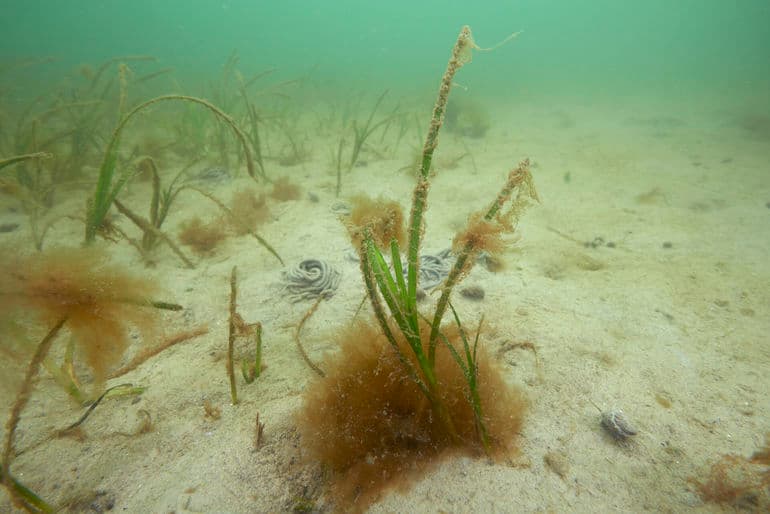
On the sea floor are potato-like tubers – so-called manganese nodules – which are a potential gold mine in the hunt for critical metals and minerals.
The black lumps contain sought-after metals and minerals such as cobalt, lithium, copper and nickel, which the world craves for all kinds of technology, including wind turbines, solar cells for mobile phones and computers.
That is why both researchers and industry have their eyes firmly fixed on the tubers. Most recently, Donald Trump signed an executive order that will make it possible to use deep-sea mining to vacuum the sea floor.
The problem is that not much is known about how mining and harvesting the precious lumps affects the sea floor and the life there. A recent study published in Nature has attempted to get closer to an answer to this, writes Videnskab.dk.
Surprise among the results
Scientists from the British National Oceanography Centre (NOC) have examined traces from one of the first industrial experiments with deep-sea mining on the bottom of the Pacific Ocean 44 years ago. Some of the life had disappeared, but the researchers also found some signs of 'biological recovery' among small animals in the upper sediment layers.
And they conclude that the spreading of the sediments that took place during the mining project "had limited long-term physical impact and no detectable negative effects on the number of animals," according to the press release for the study.
Previously, the idea among researchers has been that the whirlwind of sediments and the pollution it resulted in would have a major negative impact on life on the seabed.
The conclusion also surprises Julia Otte, who is a researcher at the Max-Planck Institute for Marine Microbiology and has herself been on an expedition that has examined manganese nodules in the Pacific Ocean.
- That conclusion is based on a mining test on a very small scale, which is not at all comparable to the kind of deep-sea mining that is expected in the future, she tells Videnskab.dk.
So here's one should be very careful about saying that there is no immediate negative effect, she objects.
Industry and politicians are pressing
If it were to happen according to all the rules of science, a team of researchers would have the long-term task and responsibility of obtaining samples, freezing them and then opening the freezer again after 40 years to compare them with new samples, is Julia Otte's call.
On the other hand, industry and politicians, including President Donald Trump, are pushing to boost deep-sea mining.
- If the green light is first given, then the harvest will start in earnest, and there will be a kind of war for the deep sea, where everyone wants their piece of the pie and tries to collect something, says the microbiologist.
- If we knew that manganese nodules were like carrots, and we knew that they would grow in the garden again next year, it wouldn't be no problem harvesting them. But they take millions of years to grow, without us fully knowing how, she says and concludes:
- It's not the first time that we've harvested something from the ocean floor, we already do that with oil. But now we have a new chance to do it better and with more protection for the life down there.
Videnskab.dk has contacted several of the study's authors for comment. They have not returned.
Text, graphics, images, sound, and other content on this website are protected under copyright law. DK Medier reserves all rights to the content, including the right to exploit the content for the purpose of text and data mining, cf. Section 11b of the Copyright Act and Article 4 of the DSM Directive.
Customers with IP agreements/major customer agreements may only share Danish Offshore Industry articles internally for the purpose of handling specific cases. Sharing in connection with specific cases refers to journaling, archiving, or similar uses.
Customers with a personal subscription/login may not share Danish Offshore Industry articles with individuals who do not themselves have a personal subscription to Danish Offshore Industry.
Any deviation from the above requires written consent from DK Medier.