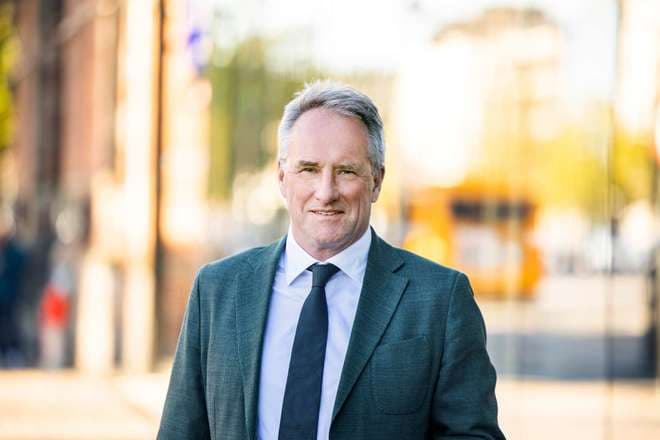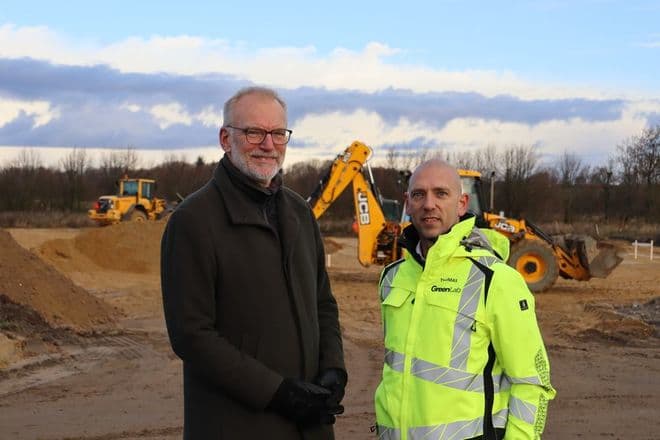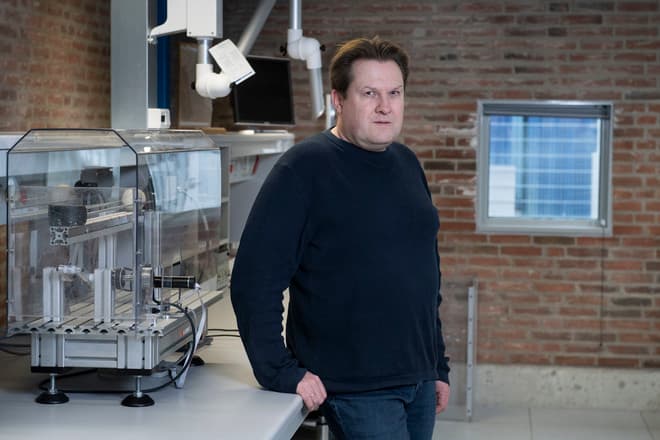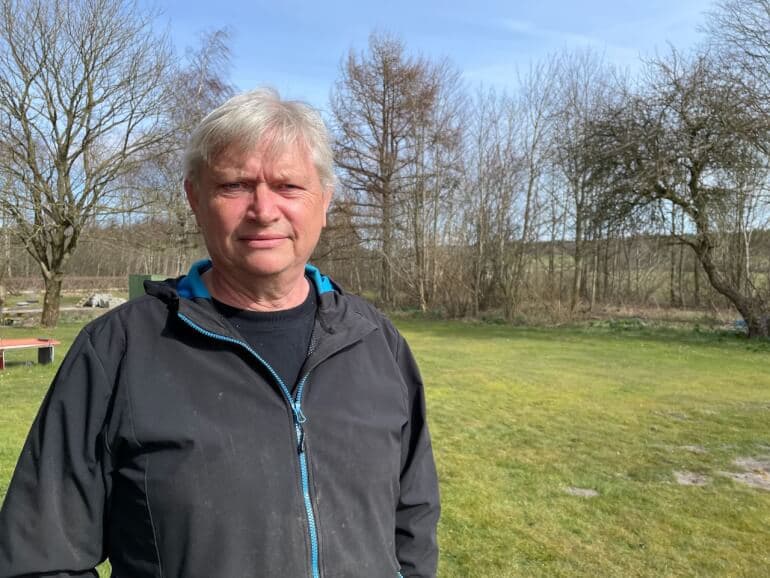
There is peace, quiet and a view of green fields at Hans Chr. Knudsen's home a few km outside the village of Kibæk. The solar cells have long since been installed on the roof, and a homemade wilderness bath with its own solar cells is almost finished. He made the latter himself, and there is even a wood-burning boiler for the coldest days when the sun does not shine. Hans Chr. Knudsen has his hands full, and it is not just a hobby, it is already 40 years ago that he, at the age of 19, was trained as a plumber and plumber in Thyregod.
- Actually, I could soon go to Arne pension, says Hans Chr. Knudsen in a way that clearly shows that he is in a completely different place in life.
At 59, he is already part of the PtX wave that is being dreamed of all over Denmark. But Hans Chr. Knudsen is far ahead of the plans gathering dust in his desk drawers, because he already has nine years of practical experience with PtX.
It began in 2013, when after working 20 years as a gas technician at Naturgas Midt-Nord, he had managed to be a teacher for a year at Herning Technical School before coming to Ringkøbing-Skjern Forsyning, which at the time had plans to establish a gas pipeline. It was a task that interested him.
- I really know something about gas from my 20 years as a gas technician, where I worked partly with regulatory supervision and data collection and monitoring. And I have worked on many different process plants at industrial customers, and that gives a good idea of what can be done, says Hans Chr. Knudsen.
Ended up at a small company
But the extensive experience was not used there, because the gas pipeline never came to fruition. Perhaps it was pure luck, because Hans Chr. Knudsen ended up working instead with the company Electrochaea, which borrowed money from Testcenter Foulum, which is part of Aarhus University. Here, a test reactor was borrowed, and PtX was to be made.
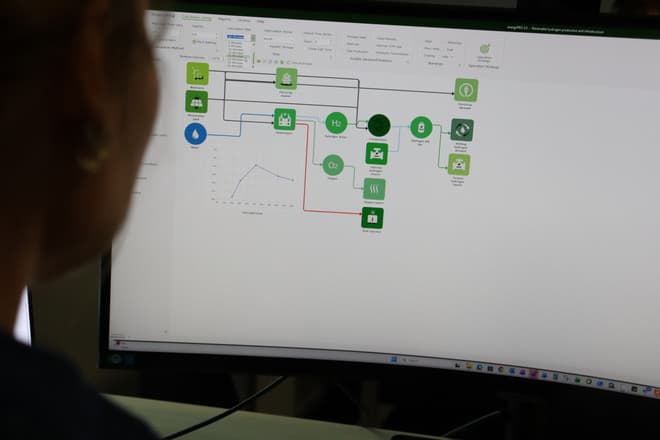
The process was that electricity was made into hydrogen through an electrolyzer. The hydrogen was then mixed with CO2 from a biogas plant and archaea in a reactor, when various salts and minerals were then added, the process ended up turning the X into methane. In other words, it became power to gas. Archaea are natural microorganisms that come from the volcanoes in Iceland.
At that time, Electrochaea was a small company with two or three employees. It would turn out to be a success both for the development and for Hans Chr. Knudsen, because when the process was moved to a smaller high-pressure reactor, he was the only one operating the project. The head of Elesctrochaea, the American Mich Hein, who was also involved in the project, was away for long periods.
The high-pressure reactor had to be depressurized every time salts and minerals were added to the process. It was time-consuming, and gas production came to a standstill, which irritated Hans Christian Knudsen a bit.
- I thought something had to be done. There was a stub where I thought it must be possible to add salts and minerals that way. But it was American threads, so I had to turn the parts at home on my lathe, says Hans Chr. Knudsen.
That made it possible to install a valve and a filling box so that the bubbling power-to-gas process was not interrupted.
"What have you done?"
A power-to-gas plant with hydrogen, CO2 and archaea under high pressure can be a dangerous business, but again experience comes into play.
- You have to respect it, because there is both hydrogen and chemicals, and you can never be too busy. I'm used to doing safety checks, and that helps, he explains.
The new addition to the plant also worked beyond all expectations. The gas quality was suddenly in a completely different league.
- After I made that change, the gas quality was over 90 percent, and we had never had that before. The methane was of a quality that could be put into the natural gas grid, says Hans Chr. Knudsen.
It wasn't long before he got an excited call from his boss Mich Hein.
- Mich said, "What have you done," he says of a change that earned praise.
The breakthrough meant that Hans Chr. Knudsen ended up being permanently employed at Electrochaea as head of operations & maintenance.
1 MW PtX in Avedøre
The next project ended up being a 1 MW power-to-gas test plant in Avedøre, which Hans Chr. Knudsen helped build and operate in the period 2015-2019. Here, gas was delivered to the natural gas grid.
He has since helped build another smaller test plant in Solothurn and a laboratory in Munich. Electrohaea has since grown to have just under forty employees and moved to the Bavarian capital to be closer to investors, including German carmaker Audi.
Now Hans Chr. Knudsen is working with his colleagues to move the electrolyzer from the test plant in Avedøre to the German town of Pfaffenhofen, where the city's energy supply Stadtwerke has plans for PtX.
When Hans Chr. Knudsen looks back on his beginnings with PtX nine years ago, there are a number of things he has learned.
- A PtX plant must be flexible, so that a filter can be built in or a sample can be taken midway. It may be that there is too much moisture, so there must be a way to get rid of the moisture. But it can be cheated by a calculation, which is why flexibility is so important. It has saved us many times that I have the practical experience, he says.
The missing framework conditions
The relocation of the electrolyzer and a possible future reconstruction in southern Germany do not change the fact that Hans Chr. Knudsen would rather work on a 10-MW-PtX plant, which is planned at Rybjerg Biogas outside the village of Roslev in Salling, than long ago.
But grid tariffs on the electricity grid mean that a grid tariff must be paid for green electricity from wind turbines or solar cells. This makes the whole thing unprofitable, even though a PtX plant could absorb the CO2 that would otherwise be emitted into the atmosphere from a biogas plant. This is the case with all biogas plants.
- Here we have the opportunity not to blow all the CO2 out of the biogas plants, and at the same time we can produce green gas. With the situation as it is now with Ukraine and Putin's gas, we should have started long ago. It can't be right that PtX doesn't work, the technology is in order, says Hans Chr. Knudsen, who, if anyone, is ready for PtX on a large scale today rather than tomorrow.
Text, graphics, images, sound, and other content on this website are protected under copyright law. DK Medier reserves all rights to the content, including the right to exploit the content for the purpose of text and data mining, cf. Section 11b of the Copyright Act and Article 4 of the DSM Directive.
Customers with IP agreements/major customer agreements may only share Danish Offshore Industry articles internally for the purpose of handling specific cases. Sharing in connection with specific cases refers to journaling, archiving, or similar uses.
Customers with a personal subscription/login may not share Danish Offshore Industry articles with individuals who do not themselves have a personal subscription to Danish Offshore Industry.
Any deviation from the above requires written consent from DK Medier.