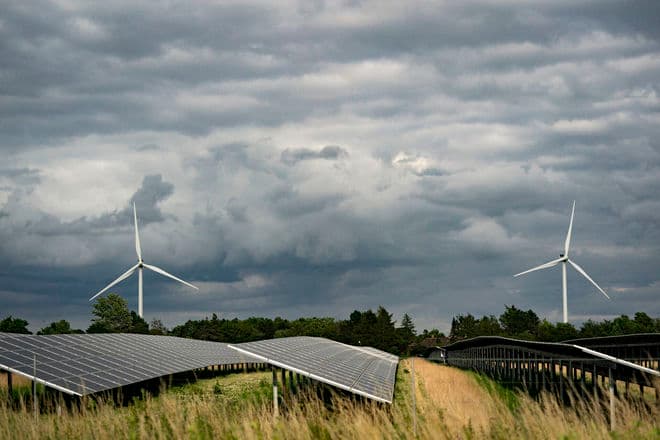
If you have solar panels on your roof and an electric car in your garage, you can, as the rules currently stand, miss out on a low electricity tax when charging your car at home. Tax Minister Rasmus Stoklund (S) wants to change that.
- We do this by proposing a sub-meter model, where you can read from people's own electricity consumption how much they charge their electric car, and that way they can get the low electricity tax, says Stoklund.
With the model, the Tax Minister also wants to strengthen the incentive for people to contribute to the green transition by driving an electric car. According to the minister, many charging stations already have the necessary sub-meter. However, not all of them do. Those who do not have one will have to purchase one themselves.
- I have been informed that they are available in different price ranges, and that they cost up to 3-4000 kroner. I think you have to look at it in terms of the fact that if the alternative is to scrap the investment with solar cells on the roof, then it's a cheap way out, says Rasmus Stoklund.
- In addition, the good news is that many charging stations already have a secondary meter.
The motorists' interest organization FDM welcomes the proposal from the Minister of Taxation.
- There is no doubt that there is a need for a quick solution, and FDM is open to the idea that it is a temporary solution, says consumer economist Ilyas Dogru in a written comment.
However, he is concerned about the costs of a secondary meter, which car owners will have to purchase if they do not have it pre-installed in their system.
- We may be concerned that the high costs are not commensurate with the tax refund that solar cell owners are losing today, says Ilyas Dogru.
According to Green Power Denmark, it is unfair that owners of electric cars have been "punished financially" and therefore a solution is obvious. However, there is a challenge, points out Director of Danish e-Mobility John Dyrby Paulsen.
- It will probably not be possible to get the special meters for electric cars ready until the summer of 2026 at the earliest - and maybe even later.
- Therefore, a temporary transitional solution is needed, he says.
Danish e-Mobility proposes to exempt electric car owners with solar cells from the tax for the part of the electricity consumption for charging the electric car that occurs at night, when the solar cells are not producing.
jel /ritzau/
Text, graphics, images, sound, and other content on this website are protected under copyright law. DK Medier reserves all rights to the content, including the right to exploit the content for the purpose of text and data mining, cf. Section 11b of the Copyright Act and Article 4 of the DSM Directive.
Customers with IP agreements/major customer agreements may only share Danish Offshore Industry articles internally for the purpose of handling specific cases. Sharing in connection with specific cases refers to journaling, archiving, or similar uses.
Customers with a personal subscription/login may not share Danish Offshore Industry articles with individuals who do not themselves have a personal subscription to Danish Offshore Industry.
Any deviation from the above requires written consent from DK Medier.