


The war in the Middle East is causing the International Monetary Fund (IMF) to lower its expectations for global economic growth in 2026. This is according to the news agencies AFP and Reuters from the annual report World Economic Outlook, which was presented on Tuesday.
The IMF warns that the world economy could be "derailed" by the war in the Middle East. The conflict is causing unrest in commodity markets and sending prices skyrocketing. In January, the IMF forecast that the fund expected 3.3 percent growth in the global economy. But after the war in Iran began on February 28, the IMF has now lowered its forecast to 3.1 percent.
- We had planned to raise growth for 2026 to 3.4 percent, IMF chief economist Pierre-Olivier Gourinchas told AFP.
The IMF's projections are based on the assumption that the conflict in and around Iran will be relatively short-lived and only cause temporary disruptions to energy markets.
- We need to be very concerned about the risk that this will develop into a major energy crisis, Gourinchas warns.
A prolonged rise in energy prices will dampen growth further
In more negative scenarios, where energy prices remain high for the rest of the year, global growth could fall to 2.5 percent or even down to around 2.0 percent.
And it may well be that the world is currently in a somewhere between the relatively optimistic scenario of 3.1 percent and the more pessimistic one of 2.5 percent, the chief economist said at a press conference on Tuesday, according to Reuters.
Gourinchas added that the negative scenario becomes more likely with each passing day of disruptions in the supply of oil and gas and the resulting higher prices.
- Since 1980, it has basically only happened four times that growth has been two percent or less, says the IMF's chief economist.
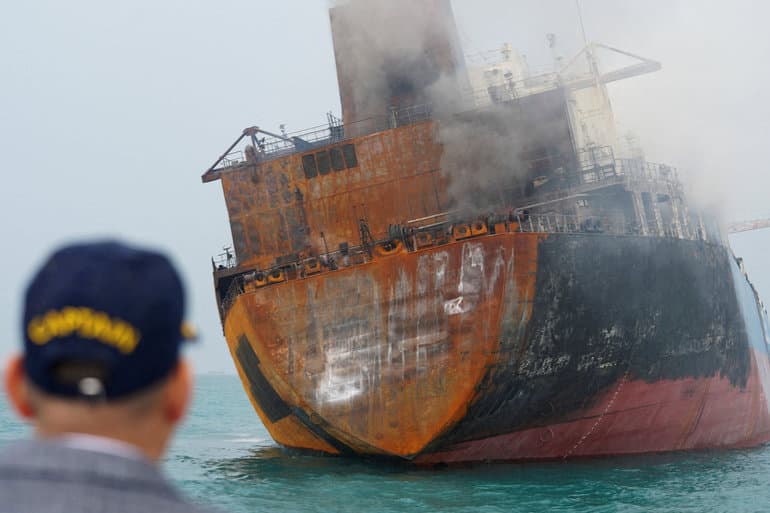
The prices of oil, gas and fertilizer have risen sharply as a result of the conflict, after Iran effectively blocked traffic through the Strait of Hormuz, a central shipping route. US President Donald Trump has also ordered a naval blockade around Iranian ports.
The high energy prices are weakening the world economy, and this will also hit Danish export companies, expects Allan Sørensen, chief economist at the Confederation of Danish Industry (DI).
- The IMF's forecast is based on the conflict lasting a few more weeks and the situation being normalised over the summer. However, the situation in the Middle East seems very fragile. Unfortunately, it cannot be ruled out that we will see a deterioration again, he says in a written comment.
Lower growth in the eurozone
The forecast for Europe does not look promising either, he adds. According to the IMF, the eurozone will only achieve growth of 1.1 percent in 2026 and 1.2 percent in 2027.
Europe's largest economies are having difficulty getting their growth going. Neither Germany, Italy, France or the UK will get growth above one percent this year.
- War in Ukraine and the Middle East, customs walls in the US, tough competition from Asia and weak growth south of the border. Danish export companies are facing very uncertain times and facing challenges around the world, says Allan Sørensen.
The IMF now expects higher inflation this year of 4.4 percent, which is 0.6 percentage points above the forecast from January.
/ritzau/
Text, graphics, images, sound, and other content on this website are protected under copyright law. DK Medier reserves all rights to the content, including the right to exploit the content for the purpose of text and data mining, cf. Section 11b of the Copyright Act and Article 4 of the DSM Directive.
Customers with IP agreements/major customer agreements may only share Danish Offshore Industry articles internally for the purpose of handling specific cases. Sharing in connection with specific cases refers to journaling, archiving, or similar uses.
Customers with a personal subscription/login may not share Danish Offshore Industry articles with individuals who do not themselves have a personal subscription to Danish Offshore Industry.
Any deviation from the above requires written consent from DK Medier.