Great uncertainty about the effect of new climate initiatives means that the government cannot be sure of achieving the 2030 climate target.
The Climate Council, which advises the government on the green transition, stated this in a comment on Thursday about the government's climate program from September.
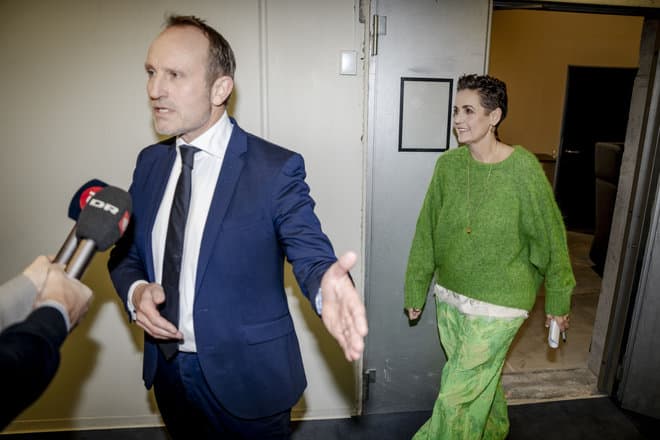
- There are great uncertainties about several of the initiatives, and if emissions are even slightly higher than the government expects, new climate policy will be needed to achieve the target, says Peter Møllgaard, who is the representative of the Climate Council.
Among other things, there is a risk that an important technology such as CO2 storage - also known as CCS - will not meet the government's expectations. CCS is a relatively new technology, and it has not yet been seen on a large scale in Denmark.
More uncertainties
There are also more uncertainties regarding the agreement on the green tripartite, which is currently being negotiated. Here there is also a risk that pyrolysis will not meet the government's expectations.
Pyrolysis is a technology where agricultural residues, such as straw, are used to produce green energy and biochar.
The Climate Council also assesses that the pace of removal of carbon-rich low-lying soils and planting of forests, which are also part of the green tripartite, must be significantly increased if the climate goals are to be achieved.
With the government's climate initiatives, the 2030 target is just reached. But it is unclear what the government intends to do if something changes, the Climate Council believes. Denmark's climate target for 2030 involves a 70 percent reduction in greenhouse gas emissions compared to 1990.
Minister of Climate, Energy and Utilities Lars Aagaard (M) believes that there is a need for follow-up and attention to pitfalls if the climate targets are to be achieved.
- The road has been drawn, but there may be bends along the way. I can guarantee that we will continue to make the necessary decisions and that we are prepared to follow up, says the minister in a written response.
But the government also lacks a longer-term plan if Denmark is to meet climate goals further into the future.
- We need a strategy that reaches further ahead than 2030. If we are to achieve the long-term climate goals, we must start planning now, says Peter Møllgaard.
Strategy must be continuously adapted
In 2045, Denmark must be climate neutral, and in 2050 there must be a 110 percent. reduction in greenhouse gas emissions.
- Much can change in the time leading up to 2045 and 2050, and the strategy should be continuously adapted in line with new knowledge and technology, says Peter Møllgaard.
At the same time, the Climate Council is demanding that the consumption-based climate footprint, which includes Danes' consumption both at home and abroad, become part of the government's climate plan. In 2022, the government highlighted in its government foundation an ambition to reduce the climate footprint of Danes' consumption.
- We assess that Denmark's consumption-based climate footprint should be addressed in a more targeted manner as an important part of Denmark's overall climate efforts, says Peter Møllgaard.
Every year in September, the government must present calculations of whether the climate goals can be achieved with current initiatives and legislation. Subsequently, the Climate Council will provide comments on the climate program.
Updated with comment from Lars Aargaard.
/ritzau/
Text, graphics, images, sound, and other content on this website are protected under copyright law. DK Medier reserves all rights to the content, including the right to exploit the content for the purpose of text and data mining, cf. Section 11b of the Copyright Act and Article 4 of the DSM Directive.
Customers with IP agreements/major customer agreements may only share Danish Offshore Industry articles internally for the purpose of handling specific cases. Sharing in connection with specific cases refers to journaling, archiving, or similar uses.
Customers with a personal subscription/login may not share Danish Offshore Industry articles with individuals who do not themselves have a personal subscription to Danish Offshore Industry.
Any deviation from the above requires written consent from DK Medier.